PERSONAL & INSTITUTIONAL SAFETY
OPA Incident Platform
Emergency SOS, SafeWalk, location intelligence, incident coordination and accountable response workflows.
Explore Incident PlatformEnterprise Safety Infrastructure
OPA connects people, facilities and authorized response teams through a controlled incident lifecycle—from activation and location intelligence to coordination, closure and audit.
Start the emergency workflow
Identity, authority and location
Connect authorized teams and incident context
Maintain closure, evidence and accountability
OPA Technologies / Solutions
Protect people and coordinate emergencies with OPA Incident Platform. Strengthen institutional security investigations with BankShield.
PERSONAL & INSTITUTIONAL SAFETY
Emergency SOS, SafeWalk, location intelligence, incident coordination and accountable response workflows.
Explore Incident Platform
BANKING & INSIDER RISK
Purpose-bound access assurance, restricted-area security intelligence and accountable investigations.
Explore BankShieldThe OPA platform
Protection should begin before an emergency happens.
OPA connects personal protection, institutional response, location context, operational accountability and incident history into one coordinated safety platform.
One lifecycle
Before
Prepare people and organizations with journey protection, trusted contacts and controlled access.
During
Bring emergency alerts, location context and authorized security teams together when an incident occurs.
After
Maintain a clear incident record for accountability, review and operational learning.
OPA connects people, security teams and authorized response organizations through a structured emergency workflow—providing incident context, location intelligence and operational visibility when every second matters.
OPA Safety
Emergency SOS, Journey Protection and SafeWalk work together across immediate emergencies, active journeys and expected-arrival protection.
Activate an emergency incident with location context and authorized notifications when immediate help is needed.
Maintain safety and location context during active journeys, including recovery when connectivity is interrupted.
Use expected-arrival protection for personal journeys with controlled guardian escalation and private-by-default boundaries.
OPA Command
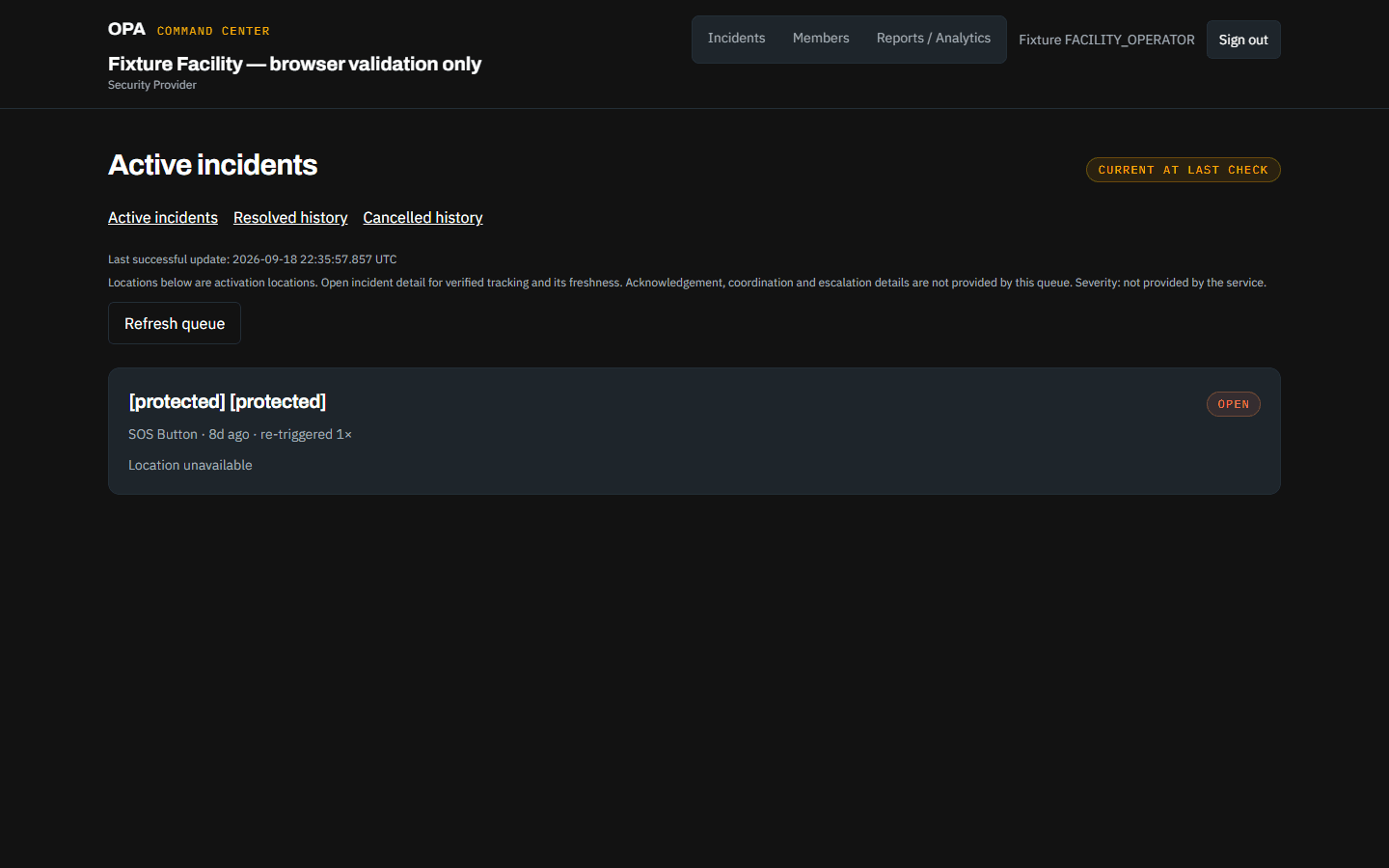
The OPA Command Center brings facility-scoped incident information, location context and auditable activity into a secure, role-based workspace for authorized teams.
Platform-level provisioning, access control and administrative oversight.
Controlled membership and institutional boundaries.
Facility-scoped administration and role-aware operational access.
Verified membership and controlled access to OPA safety services.
Role-based access helps ensure each user sees only the information and actions authorized for their role and facility.
Explore institutional operations →OPA Shield
OPA Shield connects protected identity, organizational context and authorized actions to safety operations, helping organizations maintain clear access and accountability boundaries.
Protect sensitive identity while giving authorized teams the context required to respond.
Apply facility and role boundaries so operational access reflects authorized responsibilities.
Preserve attributable actions and evidence provenance across the incident lifecycle.
Extend identity, authorization and accountability boundaries across contractors, vendors and other authorized third parties.
OPA Insight
Incident history gives authorized teams a record to review together, supporting accountability and operational learning.
Review the recorded sequence, location context and attributable actions to inform human decisions.
OPA Connect
Connect enterprise systems to OPA through controlled APIs, event integrations and institutional identity.
Integrate authorized business and security systems with OPA through deployment-specific API access and controls.
Connect incident and operational events to approved external workflows where supported webhook integrations are available.
Connect supported institutional identity providers to OPA with controlled authentication and role-based authorization.
API access, webhook delivery and identity-provider compatibility depend on the deployment, supported interfaces and applicable security requirements.
ENTERPRISE CONNECTIVITY
Extend OPA across your organization through secure APIs, integration workflows and enterprise identity architecture.
Connect authorized business applications, security platforms and institutional systems to supported OPA safety and incident workflows.
Secure integration architectureEnable event-driven connectivity between OPA and external systems through integration-specific event delivery.
Event-driven integrationConnect institutional identity and access workflows with Microsoft Entra ID, organizational roles and controlled authentication.
Enterprise identity integrationIntegration availability, supported events and identity configuration are confirmed for each institutional deployment.
Discuss enterprise integrationHuman risk, insider-risk context, branch safety and high-security operations.
The OPA Intelligence Layer
OPA is designed to bring authorized operational signals into a common intelligence model while keeping human decision-makers responsible for interpretation and action.
Core intelligence path
Intelligence → Command → Evidence → Insight
Connect authorized safety, identity and organizational context to support informed human decision-making.
Extend journey and incident context toward fleet operations, vehicle events and mobility systems.
Connect field operations and incident context with authorized infrastructure and telemetry sources.
Extend identity, workforce and incident context across safety-critical ground and aviation operations.
Create an integration path for authorized spatial, sensor and aerial context where operationally appropriate.
Connect incident context, coverage and authorized response organizations across coordinated response workflows.
Human Risk Intelligence builds on OPA's safety, identity and operational context. Fleet, infrastructure, aviation, spatial and response-network intelligence describe platform directions whose availability depends on supported integrations and deployment scope. OPA provides context for authorized human decision-makers; it does not autonomously determine intent or disciplinary outcomes.
Trust controls
Useful operational context. Controlled identity access. Evidence your organization can review.
Organization and facility boundaries restrict institutional access across tenants.
Operators hold tenant-scoped authority; platform Super Admin authority remains separate.
Sensitive identifiers are masked by default in supported institutional workflows, with privileged resolution restricted and auditable.
Controls apply to supported workflows; this is not a claim of zero access or application-wide encryption.
OPA’s identity architecture connects institutional authentication, membership, roles and session controls.
Institutional access follows membership, roles and session controls.
OPA uses Microsoft Azure-hosted infrastructure with secure transport, managed identity and least-privilege access controls.
Hosting architecture and deployment-specific data flows are reviewed during enterprise due diligence; hosting alone does not establish regulatory compliance.
Supported incident, access and delivery records preserve attributable operational history.
Integrity verification helps make unauthorized or unexpected changes detectable while outcomes remain tied to the evidence available.
Environment separation, pre-deployment validation and controlled release gates support accountable software delivery.
Detailed release and security evidence is shared through qualified procurement review.
Qualified enterprise customers may request deeper information during procurement, security review or an appropriate NDA process. Scope and available materials are confirmed individually: architecture, access controls, retention, release practices, hosting and recovery may be discussed.
Request Security and Trust PackLet's talk
See how OPA can strengthen emergency readiness, protect your people and give authorized security teams better visibility when an incident occurs.